
(AlloDerm® & Similar Materials): Results, Risks & What to Know
What Are Dermal Grafts?
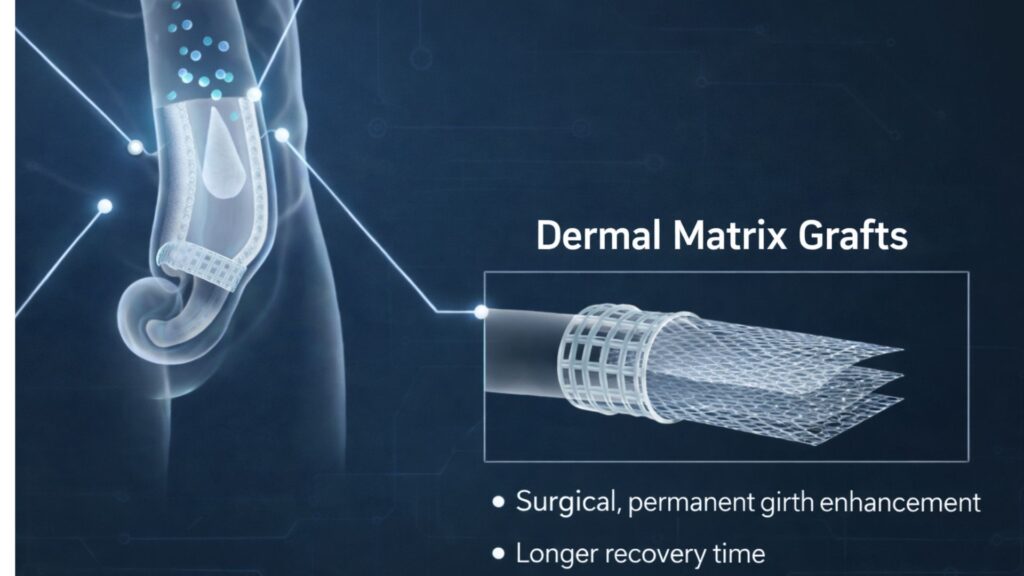
Dermal grafts are a surgical technique used in penile enlargement to increase girth (thickness) by placing biological or synthetic material under the penile skin. These grafts act as a structural layer designed to thicken the penile shaft.
The most commonly referenced material is:
AlloDerm (human-derived acellular dermal matrix)
Other similar materials include:
- Acellular dermal matrices (ADM)
- Porcine (pig-derived) grafts
- Synthetic scaffold materials
How Dermal Graft Surgery Work
This is a surgical procedure performed under anesthesia.
Step-by-step:
- The penile skin is degloved (lifted back)
- The dermal graft is shaped and placed along the shaft
- The graft is secured to underlying tissue
- Skin is repositioned and sutured
Over time:
- The graft integrates with surrounding tissue
- Blood vessels grow into the material (revascularization)
What Results Can You Expect?
Girth Increase
Typically +1 to 2 inches in circumference (varies widely
Flaccid & Erect Changes
- Increased thickness in both states
- Some improvement in perceived size and fullness
Longevity
Intended to be permanent, but:
- Results may change over time
- Irregularities can develop
Types of Dermal Grafts Used
AlloDerm® (Human-Derived)
- Processed human tissue (cells removed)
- Designed to integrate naturally into the body
Porcine Dermal Grafts
- Derived from pig tissue
- Similar structural function
Synthetic Materials
- Man-made scaffolds
- Less commonly used due to complication concerns
Clinical Evidence & Outcomes
- Dermal grafts have been used for decades in reconstructive and cosmetic surgery, but data specific to penile enhancement is limited and mixed.
Girth Enhancement Outcomes
Studies report measurable increases in circumference
- Results are highly technique-dependent
- Long-term satisfaction varies
Complication Rates
Published literature highlights risks such as:
- Irregular contouring
- Graft contracture (shrinking)
- Asymmetry
Reoperation & Revision
Some patients require:
Correction procedures
Additional grafting or removal
Important:
Unlike facial or reconstructive use, penile cosmetic use has less standardized protocols and fewer long-term studies.
Risks & Complications
Dermal graft surgery carries significant risks, including:
Aesthetic Complications
- Lumpiness or uneven texture
- Visible irregularities
- Asymmetry
Functional Risks
- Erectile discomfort
- Reduced elasticity
Surgical Risks
- Infection
- Poor graft integration
- Tissue necrosis (rare but serious)
Long-Term Concerns
- Graft contracture (tightening over time)
- Dissatisfaction with appearance
- Difficulty reversing the procedure
Unlike fillers (HA), dermal grafts are not easily reversible.
Dermal Grafts vs Other Girth Enhancement Options
| Treatment | Type | Reversibility | Risk Level | Results |
|---|---|---|---|---|
| Dermal Grafts | Surgical | No | High | Permanent but variable |
| HA Fillers (UroFill/UroScult) | Injectable | Yes (dissolvable) | Moderate | Predictable, adjustable |
| PRP (P-Shot / P-Long) | Regenerative | N/A | Low | Subtle, natural improvement |
Many modern practices are shifting toward injectable fillers due to:
Better control, Reversibility and Lower complication rates
Who Is a Candidate?
Dermal grafts may be considered for men who:
- Want permanent girth enhancement
- Understand the risks and limitations
- Are not satisfied with non-surgical options
Who Should Avoid This Procedure?
- Patients seeking low-risk or reversible options
- Those expecting perfect cosmetic symmetry
- Anyone unwilling to accept potential complications
Is AlloDerm® FDA Approved for This Use?
AlloDerm is FDA-cleared for certain reconstructive uses
However, its use in penile enlargement is considered off-label
Frequently Asked Questions (FAQ)
Is this better than fillers?
Not necessarily. While dermal grafts are permanent, they come with:
- Higher risk
- Less adjustability
Can dermal grafts be removed?
Removal is difficult and sometimes incomplete, depending on integration.
Will it feel natural?
Results vary:
- Some patients report natural feel
- Others experience firmness or irregular texture
Are results guaranteed?
No. Outcomes depend heavily on:
- Surgeon skill
- Healing response
- Anatomy
Key Takeaways
- Dermal grafts are a surgical option for penile girth enhancement
- Can provide permanent thickness, but with variability
- Carry higher risks compared to non-surgical alternatives
- Not easily reversible
- Require careful patient selection and experienced surgical technique
Final Thought
Dermal grafts represent an older surgical approach to penile enhancement that is still used today—but with caution.
While they can deliver permanent girth increases, the trade-offs include higher complication rates, less predictability, and limited reversibility. As a result, many patients and providers now favor safer, more controllable non-surgical options.
About PhallusMD
PhallusMD is a medical education platform dedicated to:
Evidence-based information, Transparent treatment comparisons. Helping men make informed decisions
We do not perform procedures—we provide clarity in a space often filled with misinformation.